
Smart VSDs for smarter warehouse stacker cranes
[Source: Mitsubishi Electric Europe]
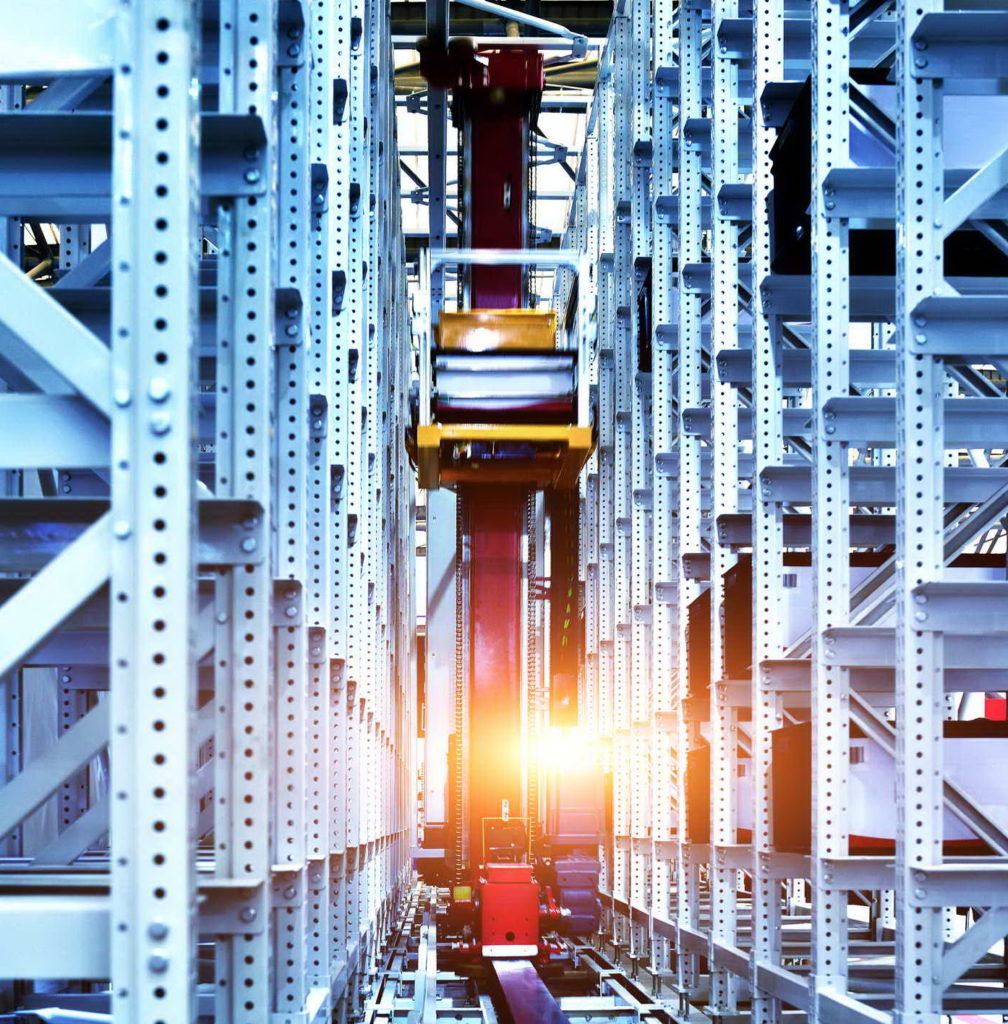
To improve throughput and space utilisation, warehouses use automated stacker cranes for the retrieval and storage of goods. Operating at high speed, these devices locate, pick, transport and unload cargo. Smart VSDs (variable speed drives) play a key role in determining their correct and effective operation.
Wayne Turtill, Product Manager – Drives, Servos and LVS at Mitsubishi Electric, explains what to look for when selecting VSDs for futureproof stacker cranes.
When specifying smart VSDs for stacker cranes, accuracy and repeatability are amongst the first considerations. To achieve these, the drives must work together with different control input types to position loading platforms, forks and trolleys. Smart VSDs allow users to create operating patterns based on key parameters such as frequency as well as s-curve acceleration and deceleration time. All these factors are important to deliver advanced positioning accuracy.
For example, drives that support closed-loop and dual feedback control via encoders and laser sensors enhance both tracking and spatial accuracy. Stacker cranes incorporating these controls shorten the time to move to defined locations and avoid unnecessary adjustments to fine-tune their positioning.
Another key function to help warehouses realise high-speed and accurate operations is anti-sway control. This minimises swing during travel and when the stacker crane reaches its destination. Since the device remains stable, loading and unloading occur sooner.
Smart VSDs
By selecting smart VSDs that interpret laser distance measurements, stacker cranes can also adapt to their environments and operational changes. For example, when detecting obstacles between the crane and the laser reflector, they can flag the anomaly and make an emergency stop. Adding extra sensor inputs contributes to system safety including detection of crane Overspeed, position deviation or proximity to the reflector.
While delivering high performance is essential for VSDs in stacker crane applications, compact size is also important. Maximising storage space in warehouses is critical, so compact drives that can control several motors are also helpful. For example, using the travel axis inverter to also control the fork axis reduces cost and space requirements. They help minimise capital expenditure while enhancing the synchronicity of the system.
A further consideration when specifying smart VSDs is the ease of installation and use. Mitsubishi Electric’s FR-A800 AWH drive provides system functions designed for automated warehouse applications. This includes the drive providing slippage prevention at the start to compensate for poor mechanical brake timing.
The drive contains other dedicated algorithms and programs for stacker cranes so that end-users need only to insert the key variables and parameters that apply to their intended system. Users benefit from the VSD’s automatic creation of operation patterns without the need to spend time developing specific controller codes.
Based on the input, the VSD selects the appropriate settings. As a result, businesses can streamline drive installation and modifications due to changes in the application. These can reduce setup times from days to a few hours.
Monitoring and maintenance
A free remote monitoring app for mobile devices provides secure and fast-tracking troubleshooting and maintenance actions. Furthermore, a durable coating applied to the drive’s circuit boards and conductors protect against failures due to moisture ingress. This maximises the VSD’s service life and resistance to warehouse environmental conditions.
A state-of-the-art smart VSDs like the FR-A800 Plus AWH can help warehouse operators enjoy accurate, repeatable and easy-to-use stacker crane systems. Its advanced capabilities also address future expectations to maintain the competitiveness of a business.
Recent blog posts